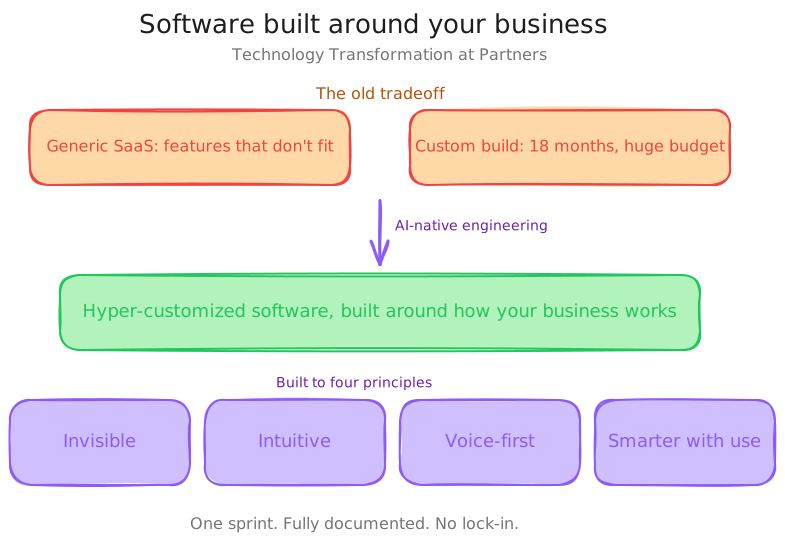
For most of the last two decades, companies buying software had two options, and neither of them was good. Option one: buy a generic platform, accept that half the features don't apply to you and the other half don't quite fit, and spend years training your team to work around the gaps. Option two: commission a custom build, wait eighteen months, spend a budget most companies can't justify, and pray the vendor delivers something usable before the requirements change.
That tradeoff is over. AI-native engineering has collapsed the cost and time of building real software to the point where hyper-customization — software shaped around how your business actually operates — is no longer a luxury reserved for the largest companies in the world. It's available to any company willing to ask for it.
This is the opportunity Partners was rebuilt around. We build custom applications, data platforms, ERP extensions, and mobile tools for companies that are tired of contorting themselves around software someone else designed.
The thesis
Generic software optimizes for the average customer. Actually, no business is average. The features that matter most to how you actually serve your clients, run your operations, and make your margin are almost always the features no off-the-shelf product gets right — because no off-the-shelf product was built for you.
The consequence is everywhere once you start looking for it. Manual workarounds. Spreadsheets glued to systems that should have replaced them. Team members who've become full-time interpreters between the software and the business. Workflows that take three tools and two hand-offs when they should take one click.
We think the right answer isn't to train people harder on the wrong tool. It's to build the right tool.
What good software actually looks like
We build to a few principles that most enterprise software quietly ignores.
The best software is the software you don't have to touch. If a system works properly, it runs in the background and produces the outcome the business needs without a human prompting it every step of the way. Every click you have to make is a design failure the previous vendor didn't bother to fix. We treat manual steps as bugs, not features.
If it isn't intuitive, it should be replaced. Software that requires a training manual to use is software that will be used badly, if at all. We design for the person who will actually use the tool on a Tuesday afternoon while three other things are happening — not for the demo.
Voice is a first-class interface. The keyboard and the dropdown menu are not the only ways to talk to a system, and in many contexts they're no longer the best ones. Letting users interact with software by speaking isn't a novelty. It's faster, it's more natural, and — a point most teams miss — it captures far richer information than a form ever will. People share context when they talk that they would never type into a field. That context is valuable, and a well-designed voice interface turns it into data the business can actually use later.
The system should get smarter with use, not slower. Every interaction is an opportunity to capture structured information that feeds back into reporting, forecasting, and decision-making. Software that forgets everything the moment a form is submitted is wasting the most valuable thing happening in the business.
What we build
The work falls into a few recognizable shapes:
- Custom applications for operations, client service, or internal workflows that no off-the-shelf product handles well.
- Data platforms for ingestion, recording, and transformation — turning messy source systems into a clean foundation for reporting and automation.
- ERP and core-system extensions — building the functionality your existing platform should have had, without ripping it out.
- Mobile applications for teams that don't work at a desk, or for client-facing experiences that need to live in someone's pocket.
The common thread is that none of it is a template. Every engagement starts from how the business actually works and what the leader actually needs, then moves to the question of what to build.
Why we can do this now
A few years ago, a build like this would have taken a team of developers, a project manager, a lengthy specification phase, and a budget that forced leadership to treat it as a once-in-a-decade decision. That's no longer true for us. Autonomous AI-based engineering systems let a small team deliver in one sprint what used to take many engineers months to produce. The economics have shifted, and we've rebuilt how we work to take full advantage of the shift.
This is what makes hyper-customization practical. Not a slogan — an actual, buildable reality for companies that would never have considered custom software five years ago.
No lock-in. Ever.
Everything we build is fully documented and handed over to your team. You own the code, you own the architecture, you own the knowledge. If you want to take the work in-house after one sprint, you can. If you want us to keep building, we will. That choice belongs to you, and we design every engagement so it stays that way.
How to start
A technology transformation engagement at Partners is one sprint. Fixed scope, fixed price, working software in weeks. If you already know the workaround your team has been living with, the manual process that shouldn't exist, or the capability your current system is missing — that's the right place to start.