Orders, invoices, projects, cases, tickets, stock movements, time entries, pipeline activity — the raw material of good decisions is sitting inside systems the business paid for and uses every day.
We believe in a simple principle: see it to steer it. A company that can look at its own operations from several angles — financial, operational, commercial, customer — can steer with confidence. A company that can't is guessing, and the larger the organization gets, the more expensive those guesses become.
Business Intelligence is how we turn the data a company already owns into the view its leaders need to run the business on purpose rather than on instinct.
The gap we're usually called into
Most of our BI clients already have an internal data function. Sometimes it's one analyst carrying the entire company. Sometimes it's a team of five. Either way, the pattern that brings us in is consistent: something urgent or high-stakes lands on the leader's desk — a board report, an investor update, a client-facing dashboard, a cost review, a restructuring decision — and the internal team can't produce it on the timeline the moment demands.
It isn't that the internal team is weak. It's that the work requires a specific combination of business judgment and technical depth that's rare to find in any one place. You need someone who understands how a P&L is actually built, how a sales pipeline actually converts, how a project actually consumes margin — and someone who can wire that understanding into a reliable data pipeline that runs every week without a human touching it. Most internal teams have one half of that. We bring both.
That combination is why, when the reporting has to be right and it has to be now, we get the call.
What we actually do
A Partners BI engagement doesn't start with a dashboard. It starts with a question: what decision is this supposed to support, and what would a leader need to see to make it with confidence?
From there, the work follows a pattern:
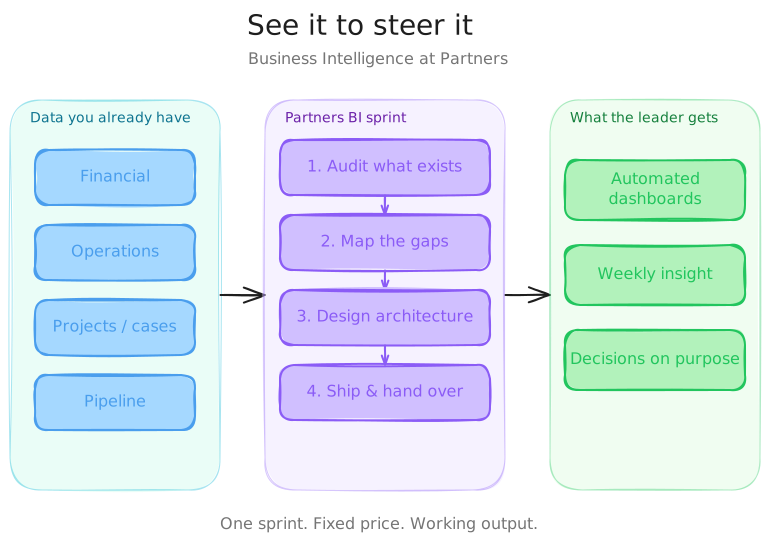
We audit what the business already has. Existing reports, spreadsheets, system exports, the logic buried in formulas no one has touched in two years. The first insight is almost always that the data is better than leadership thinks — it's just trapped in the wrong shape.
We map what's missing. Sometimes a critical data point isn't being recorded anywhere. Sometimes it's recorded in three places that disagree. We find the gaps and decide how to close them without creating more manual work for the team.
We design the architecture. Not as a one-off export, but as a system that will keep producing value on its own — weekly, daily, or in real time depending on what the decision cadence requires.
We ship it, document it, and hand it over. Fully documented. No lock-in. The client's internal team can take over the work the moment they want to.
The kinds of data we work with cut across the business: financial reporting and revenue analytics, stock and inventory, project and case data, service requests, sales pipeline, utilization, productivity, customer behavior. The outcomes cluster into a few recognizable shapes — utilization gains, lost-opportunity recovery, cleaner financial reporting, and the surfacing of specific actions that leaders can take this week rather than next quarter.
A pattern, not a one-off
One example of the shape of this work: Kontentino, a SaaS company that needed financial reporting it could actually trust. We started by auditing the reporting they already had, then ran a deep review of the underlying logic and data sources. What came out the other side was highly reliable financial reporting the leadership team could use to steer the business — not a snapshot, but a system.
That engagement is representative, not exceptional. The pattern repeats across clients in professional services, property services, IT, media, and education: leaders who knew something was wrong with the view they had, and who needed someone to rebuild it fast and rebuild it right.
Something else tends to happen along the way. Once the primary reporting problem is solved, the same engagement almost always surfaces three to five more opportunities the internal team hadn't had the capacity to pursue — data quality issues worth fixing, automations worth building, reports worth replacing. The first sprint answers the original question. The work that follows is usually worth more than the question that started it.
How to start
A BI engagement at Partners is one sprint. Fixed scope, fixed price, working output in weeks, full documentation, no lock-in. In many cases one sprint is enough to remove the immediate pain entirely. In others, it's the beginning of a longer relationship — but that's a decision the client makes after seeing the work, not before.
If you already know the report you can't get, the dashboard that doesn't exist, or the question your current reporting can't answer — that's the right place to start.